
Christopherus math through the grades
A holistic math curriculum
At Christopherus we are proud to provide a math curriculum based on the holistic reality of numbers and operations, grounded in the child’s own experience and deepened from grade to grade. From collecting nuts to memorizing math facts, from freehand geometry to modeling the Platonic Solids, our math curriculum, flowing from the profound knowledge of the child’s developmental stages as expressed by Waldorf education, is filled with the beauty and mystery of math.
We begin in first grade. We provide a story about squirrels collecting nuts: in most parts of the world, the children can observe squirrels doing just that (Australians have to find a different animal to use!). Through their nut collection activities, the squirrels in the story share (division), store away (subtraction), find more (addition) and find lots more (multiplication)! The four processes are presented together and the profound truth of mathematics, that at its core it is a whole, is thereby experienced by the children. They are not pulled out of their experience by abstraction but rather, their natural stage of learning at this tender age is honored and utilized.
In second grade the story continues and now the squirrels go up and down a tree as they work with their nuts. Thus the four processes move from the horizontal to the vertical. Colored stripes the child colors onto his tree helps him keep multi-digit numbers neatly in order. This is not about ‘making it pretty’. Over the years, one of the main ways that children become discouraged by math is the confusion which results from an inability to keep their written number work from getting tangled up. A solid foundation for orderly work is laid by this simple aid.
Number Journeys
Number Journeys start late in first grade or in second grade. We progress from ‘Sara went to the orchard and picked 5 apples. She gave 3 to her mother. How many did she have left?’ to ‘Sara went to the orchard. She picked 5 apples from one tree and 5 from another. She gave her brother Toby 2 apples. At home she gave half of her apples to her mother and kept the rest. How many did she have?’ And as the child gets older, we ditch Sara and simply say ‘Take 100. Divide it by 4. Add 6. Subtract 11. Divide by 2. What have you got?’
By working with Number Journeys, we help a child learn to focus, concentrate and exert his powers of memory. If he gets lost on his journey he cannot solve the problem—this has nothing to do with what his parent-teacher says. The work itself demands he do what is necessary. This is an important pedagogical moment in homeschooling which helps avoid head-to-head arguing. If you don’t know how to divide, then you cannot do this work. If you cannot keep track as we move along with the narrative, you will get lost. Simple as that.
Such lessons come again and again. In third grade the main focus in math is on measurement. The child has ample opportunity as she makes her own measuring devices and goes around the house and yard measuring to be accurate. Again, during the course of weather studies and her building, gardening and cooking lessons she needs to be absolutely accurate when she records and uses her measurements. There is no point arguing with mom about this—it has nothing to do with mom and everything to do with the requirements of the work at hand. You don’t measure the wood accurately, the rabbit hutch door won’t shut. You don’t measure baking ingredients carefully and the cake won’t rise. And so on.
Fourth and Fifth Grade Math
Fourth grade is mainly a year focused on consolidation—those darn tables just need to be memorized and that’s that! There is a lot of drill work via ‘math facts’ and timed math sheets—this is not about drudge and horror but about the child challenging himself to learn. He is taking a tiny step toward independence and independence brings responsibility. He just needs to roll up his sleeves and tackle math! Area and perimeter are also introduced, tied in with the fourth grade geography block which is focused on local geography. (By the way, our 4th grade math is sold separately from the curriculum—though it is of course an integral part—and there is a metric option for those outside the USA.)
In fifth grade we introduce Key To math booklets, consumable math workbooks which take one subject at a time and gradually progress in difficulty (they are available from many online sources including here). We use Key To in part because despite my tough talk regrading fourth grade math, the gap between ‘good math students’ and ‘poor math students’ is beginning to show. For some this is no problem. I have seen poor math students arrive in high school barely able to work with the four processes and seen them wake up to the exciting world of higher math. They then clearly saw the need to just learn those darn multiplication tables and did so at a rapid pace. And of course, in high school there are also plenty of youngsters who just are not math students. And that is no disaster. One can choose to hire a tutor at this point or just let it be and watch your son or daughter excel in other realms.
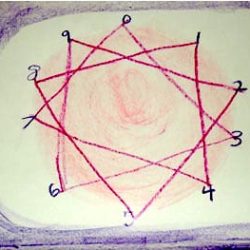
Fifth grade is also the time for geometry to begin. This is freehand non Euclidean geometry and has nothing to do with proofs and everything to do with the sacred nature of mathematics as revealed through geometry (so don’t jump ahead and get Key To booklets on geometry as you will thereby shortchange your child of the extremely important experience of form and number expressed through geometry). Your child will remember how the 12 numbers were presented to him in first grade—he now gets to see this again, but in a deeper way, as experienced through geometry. Botany studies this year reveals the geometry of flowers. In seventh grade this is taken further with study of topics such as the Fibonacci series and the Golden Mean—both reveal the mystery of mathematics in nature. Read here how Christopherus form drawing lays the basis for geometry.
Sixth Grade Math
Geometry in sixth grade heralds our work with compass and ruler. We lay the foundations for geometric proofs and for later study of trigonometry in high school by slowly grounding the student in the experience of geometry and leaving abstractions for later, when she is ready for it and can then excel. And yes, of course there are excellent math students out there who have not taken this rather slow approach that we favor. But the point is to make mathematics—like music and literature and science subjects—available and relevant to all. Those who excel, will do so. But those who struggle will at least have a good shot at going as far as they can.
One of the really positive sides to homeschooling is the opportunity to work deeply with various subjects in a way that simply is not possible within the confines of the classroom. Our cooking curriculum which spans the grades is an example of this: it carries geography, math and science lessons in a wonderfully practical way. Our botany studies (5th grade) and earth science studies (6th grade) begin with where you are, what grows in your location, what geological formations are found there, what biome you are in. Likewise, our seventh grade astronomy materials become a theme for the year, spanning 7th and 8th grade and beginning with naked eye observation and progressing to a study of such figures as Al-Baruni, Copernicus and Kepler. By observing the planets and stars over the course of a year, the child gets a much more realistic experience of the movement in the heavens than by any classroom course.
In math, we at Christopherus are especially pleased by our 6th grade business math studies, another topic far better suited to the homeschool situation than the classroom. We encourage parents to make this a theme for the year and to help their child launch their own small business. The student is also asked to be involved in family economics, thereby learning about taxes, payroll, healthcare costs, cost of goods, labor, budgeting and so on. The study of decimals and percentages is carried by this practical work.. For some students, learning the rudiments of accounting will be called for.
The culmination of the Christopherus math curriculum
Seventh grade is the year of looking outward—the child is finally (in her eyes) a teenager and her horizons are widening. The Age of Exploration, whether by the Chinese, by Muslim scholars or by European explorers is an important theme. The Renaissance awakening in Europe was based on Greek knowledge lovingly nurtured by Muslim scholars over the centuries. Much of this knowledge involved mathematics and geometry. The aforementioned astronomers were of course all mathematicians. During his study of astronomy this year or next, your child can delve into mathematics resources provided by NASA, having to do with his study of the planets and stars. The Key To booklets help with algebra and other subjects, including geometric proofs which are based initially on the work of Pythagoras, a figure studied by your child since 5th grade.
Eighth grade rounds things off—more on fractions, percentages and decimals. Geometric proofs (Pythagorean theorem, volume, area, Platonic solids). Powers and square roots. Binary system and introduction to computers would be good if it can start with actually making a computer. Statistics and graphing. Accounting taken further than in 6th grade. Algebra.
Eighth grade can be a tricky grade for the homeschooler as much of what is taught depends on what happens in ninth grade—one wants to ensure that a student is prepared for life in school if that is where she is headed (and by the way, our video on preparing for 9th grade is a real help with thinking through such preparation). The homeschool teacher needs to either be very good with math or willing to find a teacher. Eighth grade mathematics can be very challenging and even if your child is not great at math, it would be good to not throw in the towel yet, but to find ways to inspire and interest him. If you feel this is beyond you, a tutor might be necessary—it would be ideal if s/he came from a Waldorf background but at the very least, if she is enthusiastic about her subject, then that can be enough.
Posted on February 2, 2024 in Christopherus Curriculum, General Homeschooling
-
Waldorf Homeschooling Essentials
FIND OUT MORE -

Audio Downloads
FIND OUT MORE -
Middle Grades (6-8)
FIND OUT MORE -
Lower Grades (1-5)
FIND OUT MORE -
Early Years
FIND OUT MORE -
Handwork Kits
FIND OUT MORE



Share your comments and thoughts